Monday, 8 April 2024

Why Israel withdrew troops from Gaza?

Stunning appears to be the only appropriate word for Israel’s withdrawal of troops from Khan Yunis in southern Gaza on Sunday. Some political and defense officials tried to offer apologetics for how it was hinted to, or consistent with Israel’s strategy to date – but it simply was not.

The clock is running out on Hamas’s potential return, invading Rafah, and the fate of the hostages.

For months, Israel’s consistent strategy was that the only way the IDF could convince Hamas to return more hostages would be to pressure it in its hometown of Khan Yunis.

Hamas Gaza chief Yahya Sinwar and military chief Muhammad Deif are both from Khan Yunis; it would be personal for them.

The best Hamas fighters were from Khan Yunis – losing them would be unspeakably demoralizing.

An intricate tunnel network, which puts the northern Gaza tunnels to shame, was in Khan Yunis. Overtaking them after millions of dollars and years were invested in them by Hamas would take the air out of the terrorists’ sails once and for all.

This is especially true after witnessing the fall of Gaza City in northern Gaza, Hamas’s capital.

Over the last two months, the line has been that as long as the IDF kept its forces in Khan Yunis, it acted like a stranglehold on Hamas, and at any moment, the terrorist group would gasp for air badly enough to agree to a deal.

The withdrawal of forces from Khan Yunis on Sunday, then, ends this strategy, and is an admission of failure.

But, this doesn’t mean the hostages will not come home. The IDF did defeat Hamas in both northern and southern Gaza, destroyed much of its tunnel network, and killed many senior officials.

Leaving Khan Yunis now does not negate those tremendous gains, gains that have set Hamas back years in terms of military capabilities.

Now, Israel will either need a new strategy or make bigger concessions to Hamas to get back more hostages, including opening up the north of the enclave.

A new strategy could be the hope that invading Rafah will bring Hamas to its knees. By this logic, once the IDF closes in on Rafah – something Hamas believes Israel is afraid to do – Hamas will finally crack and agree to a more reasonable deal. It could even work.

There is no specific reason why Israel cannot send its forces into Rafah.

If the IDF has no presence in Khan Yunis, large numbers of Palestinian civilians may voluntarily leave Rafah and go back there without needing to be formally evacuated.

This may alleviate America’s concerns about whether Israel can successfully evacuate 1.4 million Palestinian civilians.

The IDF could lure Hamas into a false sense of security and pull off a Shifa Hospital-style clean-up operation, just as soon as the terrorist group concentrates too many of its forces in one place.

The problem with this line of thinking is that even if it is true, there was no hint to it until US President Joe Biden dropped the hammer on Prime Minister Benjamin Netanyahu on Thursday.

Netanyahu opened Erez Crossing for transferring humanitarian aid, which was never going to open again after Hamas destroyed it on October 07.

He had also opened the port of Ashdod for transferring humanitarian aid, another action he had vowed never to take.

By Friday, the IDF had fired or dismissed several very senior officers under pressure from the US and the international community for killing seven aid workers. And on Sunday, the military suddenly pulled out of southern Gaza.

Even if this truly is a new strategy and even if it might work, there is very little credible way to argue that a significant cause for the radical shift was US pressure and that the shift is an admission that the old strategy of a bunch of months has failed.

There is also an outside shot that it was part of some unofficial Cuban Missile Crisis-style secret informal deal, where if the IDF withdraws from southern Gaza, Hamas will be able to claim enough victory to make concessions to the IDF regarding the hostages and northern Gaza.

The big question now is whether this shift will be sufficient to maintain at least lukewarm US support for invading Rafah or whether America may already have decided to force Israel into a hostage deal, even if it potentially undermines finishing off Hamas.

Washington supported Jerusalem for almost six months and through 33,000 dead Palestinians, but finally hit its breaking point.

While people wait for that question to be answered, Hamas will at minimum be able to restore some of its governance in southern Gaza simply because Israel never decided to allow anyone else in to take over.


Why Pelosi remained silent for six months?

Representative Nancy Pelosi, the former speaker of the House of Representatives and a key ally of Joe Biden, signed a letter on Friday from dozens of congressional Democrats to the president and Secretary of State Antony Blinken urging a halt to weapons transfers to Israel.

The letter by Pelosi and 36 other Democrats came after Israel on April 01 killed seven aid workers of World Central Kitchen (WCK) in Gaza. Most probably if six of the aid workers had not been citizens of the US and its allies, Pelosi and other Democrats would not have objected to the shipment of arms to Israel.

The death of the six WCK staff who bravely defied all risks to deliver food to the starved people in northern Gazans is an unfortunate and unforgettable event.

The question is why no official voice came from Pelosi during six months of Israel’s genocide against the defenseless Palestinian citizens in Gaza.

She raised objections to sending arms to Israel after a dual American-Canadian national, three Brits, an Australian, and a Pole were killed in the Israeli airstrike in northern Gaza, where starvation and famine are more rampant.

"In light of the recent strike against aid workers and the ever-worsening humanitarian crisis, we believe it is unjustifiable to approve these weapons transfers," the letter said.

Pelosi is well aware that since October 07 Israel has killed over 33,000 people, which shows that on average 183 Palestinians have been massacred per day. This is without counting thousands of bodies buried under rubble and those who have lost limbs or got paralyzed for life.

There is a question how Pelosi as a mother has been feeling about Palestinian mothers who are seeing their children go without food and water and being dismembered and massacred by the US-supplied fighter jets.

How many more children and women should have been killed by mostly American-made weapons until Pelosi and 36 fellow Democrats talk about the ever-worsening humanitarian crisis in Gaza?

It is highly unlikely that Biden and his inner circle would listen to Pelosi and other co-signers of the letter on weapons transfers to Israel because Biden has been boasting that he is a Zionist and If there were not an Israel, we'd have to invent one. 

The Biden administration is not backing calls for an independent, third-party investigation into the Israeli strike that killed the WCK aid workers.

As House speaker Pelosi stood strong against Donald Trump’s reckless foreign policy and rash behavior when he was president but she reacted too late to the hell that Israel has created in Gaza and only when six aid workers of the US-based WCK were killed in the besieged coastal enclave.


Pakistan’s antagonized relations with its neighbors

Pakistan's relationships with its neighboring countries have been strained for several decades, with current tensions particularly evident with Iran, Afghanistan, and India. These strained relations stem from a complex history and various geopolitical factors.

Historically, Pakistan enjoyed close ties with Iran, notably during the RCD era. However, following the revolution in Iran, relations soured, partly due to pressure from the United States. US-imposed sanctions on Iran and efforts to isolate it, including influencing Saudi Arabia to sever ties, further exacerbated tensions. Allegations suggest that countries like Saudi Arabia and Kuwait supported Iraq during its decade-long war with Iran.

The Iran-Pakistan-India (IPI) gas pipeline project, once of significant importance, faced setbacks due to US influence. India, under US pressure, withdrew from the project, citing the threat of economic sanctions. In an attempt to mitigate these challenges, Pakistan turned to Saudi Arabia for crude oil supplies on deferred payment terms.

Despite hopes for improved relations following diplomatic efforts brokered by China between Saudi Arabia and Iran, ongoing cross-border terrorism activities between Pakistan and Iran have hindered progress on projects like the Iran-Pakistan gas pipeline.

The relationship between Pakistan and Afghanistan has been marked by fluctuating dynamics, oscillating between cooperation and hostility. India's involvement, including support for anti-Pakistan elements in Afghanistan and participation in infrastructure projects like the Chabahar Port, has further complicated matters, seeking to undermine Pakistan's regional influence.

US foreign policy interests heavily influence the dynamics between India and Pakistan, with the former receiving substantial military support to counterbalance China, often at Pakistan's expense. Some analysts believe that entrenched hard-line positions in both countries will continue to hinder any prospects for improved relations.

Critics argue that Pakistan's foreign policy, historically aligned with US interests, prevents the country from overcoming its most pressing challenges independently. This dependence on external support, particularly from the United States, perpetuates Pakistan's vulnerability in international affairs.

Sunday, 7 April 2024

United States: Two Party System and Militarism

US Presidential Candidate, Jill Stein has condemned Israel for its actions. She placed ultimate responsibility for much of the violence on Washington. While talking to MintCast host Mnar Adley she said, “Gaza is the key issue of our era.” She added “Every international law in the books is being broken.”

She said, “This is not something that began on October 07, 20234. This is the continuation of ethnic cleansing and displacement that began in 1947 and 1948 with the displacement of 750,000 people.”

Jill Stein, a physician by trade, has been involved in the Green movement for decades. She first ran for office in 2002, attempting to become the governor of her native Massachusetts. In 2012 and 2016, she was selected as the Green Party’s presidential candidate. Running against Donald Trump and Hillary Clinton in 2016, she received over 1% of the national vote. She is the overwhelming favorite to represent the Green Party in the 2024 presidential election.

Congress, Stein noted, has just approved US$3.8 billion in aid to Israel, with another US$17 billion pending for not only continuing its genocide but to expand its wars in the Middle East.”

Global public opinion is increasingly turning against the United States, Stein warned, turning both Washington and Israel into pariahs. Even inside the US, recent polling shows that a majority of Democratic voters consider Israeli actions to constitute genocide. And President Biden continues to offer unconditional support.

It seems this is pushing millions of voters to consider the Green Party as an alternative. Stein described the Democratic establishment as in a state of panic over the widespread revolt among its voter base, which could destroy the party’s chances of winning elections.

She said they are fielding an army of corporate lawyers to try to dirty trick us, to find little technicalities to throw us off the ballot.

This is not a new phenomenon, as the Green Party has long dealt with the Democrats’ attempts to suppress them.

However, what has changed, Stein said, is the party’s willingness to announce their intentions to limit democracy openly.


Saturday, 6 April 2024

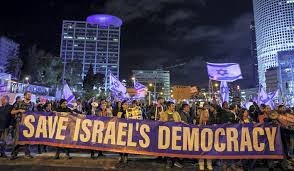
Protesters demand Netanyahu’s resignation

Protesters once again took to the streets of Tel Aviv, Caesarea and Haifa on Saturday, demanding resignation of Israeli Prime Minister Benjamin Netanyahu and early elections. The situation underlines fears that the war in Gaza could spread into a broader regional conflict.

Demonstrators also called for the release of all Israeli hostages held in Gaza ahead of the six-month mark of hostilities.

Many people waved Israeli flags and held up signs with images of hostages, calling on the government to bring them home alive.

In Tel Aviv, protesters were heard chanting: “We are not afraid; you destroyed the country, and we will fix it. We want them (hostages) back alive and not in coffins.”

Other protesters were seen by a CNN team on the ground holding flags and banners, with one reading, “The government that destroyed the country and tore the nation apart.”

Another banner called for the “division of religion and state,” and one stated that “Netanyahu is dangerous to Israel.”

Protesters in Haifa called the government a failure, saying Netanyahu is “guilty, guilty, guilty.”

“Elections now!” read one banner held by a protester.

Meanwhile, a protester was arrested for punching and injuring a police officer during an anti-government rally in Tel Aviv on Saturday, Israeli police said in a statement.

The Israel Police also warned protesters not to light bonfires as demonstrators march through the streets, saying it can be “life-threatening” around the crowd.

“We will act with zero tolerance towards those who disrupt the order and behave violently towards police officers,” authorities said in a statement.

With the war in Gaza raging for six months the patience of Israel’s allies is running out. As the death toll in the enclave continues to climb, it’s becoming increasingly clear that Israel has no viable plan for how to end the war or what comes next.

The determination to continue pursuing Hamas in Gaza despite the horrific humanitarian consequences is leaving Israel increasingly isolated on the global stage, with its government facing pressure from all sides.

Multiple international organizations have warned Israel may be committing genocide, and even the country’s closest allies are now openly criticizing Netanyahu. Calls to halt arms shipments to Israel are growing in the United States and the United Kingdom.

Netanyahu and his government are under mounting pressure at home, with protesters back on the streets in large numbers calling for his resignation.

Israel launched the war immediately after the deadly October 07, 2023 attacks by Hamas. At that time, the Israeli government said the operation had two goals: eliminating Hamas and bringing back the hostages taken by the militants to Gaza. Six months into the conflict, neither goal has been reached.

Also, speaking from a funeral procession Saturday for a slain military officer, Iran’s highest-ranking commander vowed that an Israeli strike on its embassy complex in Damascus will not go unanswered. The remarks come as the US braces for a significant Iranian attack on US or Israeli assets in the Middle East, according to a senior administration official.

Iranian LPG export on upward trajectory

Iran became the biggest West Asian supplier of Liquefied petroleum gas (LPG) last year. Its LPG exports surged 28% to over 11 million tons, according to an analysis of ship tracking data and market intelligence by consultancy Facts Global Energy (FGE). The firm expects exports to continue climbing beyond 12 million tons this year, Bloomberg reported

The increase is driven by rising production from the South Pars gas field as well as greater shipping capacity between Iran and China.

Iran exported 4.71 million tons of liquefied petroleum gas (LPG) in the first six months of 2023, according to the data released by S&P Global Platts.

Based on the Platts data, Iran's LPG exports loading in June were estimated at around 696,000 million tons, 28.5 percent less than May when 973,260 million tons of LPG was shipped.

Iran's average monthly LPG export in the first half of the past year was 784,833 tons.

Iran’s LPG exports mostly go to China despite the US sanctions, facilitated by Chinese shipowners who have developed an armada of very large gas carriers since sanctions were imposed on Iran in 2014 and then in 2018.

The Islamic Republic’s LPG exports could be higher without the restrictions that international shipping and trading firms face due to the sanctions and allow Iranian exporters to resume access to the global markets.

Liquefied petroleum gas, also referred to as liquid petroleum gas (LPG or LP gas), is a fuel gas that contains a flammable mixture of hydrocarbon gases, specifically propane, n-butane, and isobutane. It can sometimes contain some propylene, butylene, and isobutene.

LPG is used as a fuel gas in heating appliances, cooking equipment, and vehicles. It is increasingly used as an aerosol propellant and a refrigerant, replacing chlorofluorocarbons to reduce damage to the ozone layer. When specifically used as a vehicle fuel, it is often referred to as autogas or even just as gas.


Al Quds Day observed worldwide

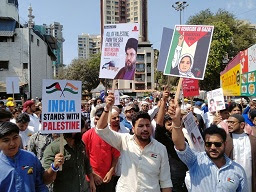
Millions of people across the world held huge rallies to mark ‘Al Quds Day’ to express solidarity with Palestinian people and condemn Israeli crimes. This year Israeli genocide in the Gaza Strip has attached specific significance. 

The event observed on the last Friday of Ramadan is commemorated by Palestinian supporters every year.  

In Pakistan, political parties including Jamaat-e-Islami and Majlis Wahdat-e-Muslimeen staged rallies across the country in support of the Palestinians and against the Israeli killing in Gaza. 

The protests were held in different cities including Karachi, Quetta, Muzaffarabad, Kashmore, Bhalwal, Parachinar, Chichawatni, Rajanpur and Jacobabad.

On the occasion, Prime Minister Shehbaz Sharif called on the international community to exert pressure on Israel to halt its oppression of the Palestinian people in Gaza.

He underscored Pakistan's unwavering support for Palestine, advocating for the establishment of an independent Palestinian state.

The premier pointed to decades-long Israeli occupation of Palestine and denounced the international community’s silence in the face of human rights violations by the regime. 

On the outskirts of Srinagar in Indian controlled Kashmir, Muslims slammed the Israeli massacres in Gaza. They called for ending the Israeli violence and genocide in the Palestinian territory. 

A massive rally also took place in Mumbai, India. The protesters expressed support for the Palestinians and their cause. They also slammed the Israeli genocide in Gaza which has left 33,000 people dead since October 07, 2023.

Indonesia was also the scene of protests against Israel on Al Quds Day. The protesters denounced the regime’s war of genocide on Gaza. They blamed the US for standing by the regime.

The demonstrators displayed a poster depicting President Joe Biden as a clown during a rally outside the US embassy in Jakarta.

Malaysians also rallied to express solidarity with Palestinian people and the cause of Palestine.  

In Thailand, people took part in a rally in support of Palestinians in front of the Israeli embassy in Bangkok. 

Bahrainis demand closure of Israeli embassy. Theycame on the streets to voice support for Palestinians, particularly the residents of the Gaza Strip. They condemned the Israeli brutality against the Gazans. 

The protesters called for the closure of the Israeli embassy in Manama and the expulsion of the regime’s diplomats from the Arab country. 

Bahrain and the Israeli regime established diplomatic relations in 2020 as part of the United States-brokered Abraham Accords.

Millions of Yemenis also marked Al Quds Day. Protesters in the capital Sana'a condemned Israel’s brutal war on Gaza. 

In a statement, the protesters said the Palestinian nation has been subjected to the US-Israeli genocide for six months. 

The statement called on all Arab and Islamic countries to fulfill their responsibilities in the face of the savagery of the US and the Israeli regime.

Other countries in the Arab world including Iraq and Jordan saw huge protests on Al Quds Day. 

Protesters in Tanzania's coastal city of Dar es Salaam also rallied as they were holding the Palestinian flag. The protesters chanted anti-Israeli slogans and condemned the regime’s vicious crimes against Palestinian people in the Gaza Strip.

Al Quds Day rallies in Nigeria turned deadly as police clashed with protesters. Reports suggest security forces killed several people in the city of Kaduna who were protesting against the Israeli crimes. 

Police used tear gas and water cannon to disperse the pro-Palestine demonstrators.

Europe also saw rallies marking International Quds Day. In Britain, demonstrators gathered outside the Home Office in Marsham Street before heading into Horseferry Road, along Millbank, past the front of the Houses of Parliament and finishing in Whitehall where speeches were delivered. Prior to the rallies, more than 500 officers were deployed in central London.

In Poland, protesters held banners as they gathered to spend night near the US Consulate in Krakow to protest against Israeli attacks in Gaza.