Saturday, 28 June 2025

Trump biggest warmonger, not peacekeeper

It’s been said that Donald Trump’s decision to join Israel’s war with Iran underscores his failures as a peacemaker. This is a preposterous statement because the idea of Trump being “a peacemaker and unifier” has always been nothing short of preposterous.

Yes, long before his ascendance to the White House, Trump had managed to paint him as a peacemaker, promising to end America’s “endless wars.” But most people in the United States of Amnesia seem to have forgotten that during his first four-year tenure in the White House Trump embarked on a dangerous path with a series of reckless foreign policy decisions that threatened peace and made the world a far more dangerous place.

Trump walked away from an Iran deal and withdrew from the Intermediate-Range Nuclear Forces (INF) Treaty and the Open Skies Treaty while US air wars became broader and “increasingly indiscriminate.”

Iraq, Somalia, and Syria were among the countries that Trump loosened the rules of engagement for US forces. Trump also ordered the killing of Iranian Gen. Qasem Soleimani and threatened “fire and fury” against North Korea.

In addition, Trump increased tensions between Israelis and Palestinians by recognizing Jerusalem as Israel’s capital and moving the US embassy there from Tel Aviv.

The president of the Palestinian Authority Mahmoud Abbas said at the time that Trump’s decision undermined all peace efforts and called his actions “a crime,” while the political leader of the Hamas movement, Ismail Haniya, who was assassinated by the Israeli Mossad in Tehran on July 31, 2024, called for a new “intifada.”

Shortly upon assuming the Office of the President of the United States for the second time, Trump embarked on a jingoistic journey by threatening to take over Greenland (an idea he had floated back in 2019), make Canada the 51st state, reclaim the Panama Canal, and attack Mexico. And just as he had done during his first term in office, he withdrew the US from the landmark Paris climate agreement, even though the climate crisis is an existential one and is expected to increase the risk of armed conflict.

PSX benchmark index up 3.6%WoW despite unrest in Middle East

Pakistan Stock Exchange (PSX) staged a strong rebound during the week following the ceasefire agreement between Iran and Israel. The benchmark index gained 4,356 points or 3.6%WoW to close at record 124,379 points on Friday, June 27, 2025.

While the week began on a cautious note due to renewed concerns over regional instability following the US attacks on Iranian nuclear facilities, the ceasefire restored investors’ confidence and triggered a sharp recovery from the second trading day onward.

Market participation dropped despite the rally, with average daily traded volume falling to 736 million shares from 822 million shares a week ago, down 10%WoW.

The foreign exchange reserves held by State Bank of Pakistan (SBP) declined sharply by US$2.7 billion to US$9.1 billion as of June 20, 2025, the second-largest weekly fall, mainly due to scheduled external debt repayments.

However, SBP reiterated its June end reserve target of US$14 billion, with US$3.6 billion inflows expected to be reflected in the coming week. Domestic currency remained largely stable at PKR283.7/US$.

The FY26 Federal Budget was approved on Thursday, with minor adjustments to tax laws and rates.

On the inflation front, headline CPI for FY26 is projected to moderate further to 4.4%YoY as compared to 4.5% for FY25, due to a moderate increase in food and housing indices.

Other major news flow during the week included: 1) Pakistan and United States eyeing preferential trade deal in talks, 2) Consumer confidence at highest since 2022, up 25%YoY in 4QCY25, 3) Power generation up 1%YoY in May 2025 on lower tariffs, and 4) RDA inflows were up 14%MoM in May 2025, to US$10.38 billion.

Woollen, Glass & ceramics, and Vanaspati & allied sectors were amongst the top performers, while Modaraba, ETFs, and Sugar & allied industries reported declines.

Major selling was recorded by Foreigners and Individuals with a net sell of US$15.8 million. Mutual funds and Insurance absorbed most of the selling with a net buy of US$16.1 million.

Top performing scrips of the week were: BNWM, GHGL, NATF, HUMNL, and PABC, while laggards included: PSEL, PKGP, PGLC, EPCL, and ISL.

According to AKD Securities, the market is expected to remain positive in the coming weeks, with forward inflation for FY26 projected at 4.4%YoY, indicating substantial room for monetary easing, which would serve as a catalyst for equities.

The KSE-100 index is anticipated to sustain its upward trajectory, primarily driven by strong earnings in Fertilizers, sustained ROEs in Banks, and improving cash flows of E&Ps and OMCs, benefiting from falling interest rates and economic stability.

Top picks of the brokerage house include: OGDC, PPL, PSO, FFC, ENGROH, MEBL, MCB, HBL, FCCL, INDU, and SYS.

Friday, 27 June 2025

Trump’s war mania

According to Reuters, US President Donald Trump sharply criticized Iran's Supreme Leader, Ali Khamanei, on Friday, dropped plans to lift sanctions on Iran and said he would consider bombing Iran again if Tehran is enriching uranium to worrisome levels.

Trump reacted sternly to Khamanei's first remarks after a 12-day conflict with Israel that ended when the United States launched bombing raids last weekend against Iranian nuclear sites.

Khamanei said Iran "slapped America in the face" by launching an attack against a major US base in Qatar following the US bombing raids. Khamanei also said Iran would never surrender.

Trump said he had spared Khamanei's life. US officials told Reuters on June 15 that Trump had vetoed an Israeli plan to kill the supreme leader.

"His Country was decimated, his three evil Nuclear Sites were OBLITERATED, and I knew EXACTLY where he was sheltered, and would not let Israel, or the US Armed Forces, by far the Greatest and Most Powerful in the World, terminate his life," Trump said in a social media post.

"I SAVED HIM FROM A VERY UGLY AND IGNOMINIOUS DEATH," he said.

Iran said a potential nuclear deal was conditional on the US ending its "disrespectful tone" toward the Supreme Leader.

"If President Trump is genuine about wanting a deal, he should put aside the disrespectful and unacceptable tone towards Iran's Supreme Leader, Grand Ayatollah Khamenei, and stop hurting his millions of heartfelt followers," Iran's Foreign Minister Abbas Araqchi said in a post on X in the early hours of Saturday.

Trump also said that in recent days he had been working on the possible removal of sanctions on Iran to give it a chance for a speedy recovery. He said he had now abandoned that effort.

"I get hit with a statement of anger, hatred, and disgust, and immediately dropped all work on sanction relief, and more," he said.

Trump said at a White House news conference that he did not rule out attacking Iran again, when asked about the possibility of new bombing of Iranian nuclear sites if deemed necessary at some point.


"Sure, without question, absolutely," he said.

Trump said he would like inspectors from the International Atomic Energy Agency - the UN nuclear watchdog - or another respected source to be able to inspect Iran's nuclear sites after they were bombed last weekend.

Trump has rejected any suggestion that damage to the sites was not as profound as he has said.

The IAEA chief, Rafael Grossi, said on Wednesday that ensuring the resumption of IAEA inspections was his top priority as none had taken place since Israel began bombing on June 13.

However, Iran's parliament approved moves on Wednesday to suspend such inspections. Araqchi indicated on Friday that Tehran may reject any request by the head of the agency for visits to Iranian nuclear sites.


India refuses to sign joint statement at China

According to Saudi Gazette, India refused to sign a joint statement at the Shanghai Cooperation Organization (SCO) summit in China as it did not reflect the country's concerns on terrorism, India's foreign ministry has said.

Spokesperson Randhir Jaiswal said on Thursday that India's desire for its concerns to be reflected was "not acceptable to one particular country".

While he did not share more details, Indian media reported that Delhi refused to sign the statement after it omitted the Pahalgam attack, a deadly militant attack that killed 26 tourists in Indian administered Kashmir.

India has blamed its neighbour, Pakistan for sheltering a militant group it blames for the attack. Pakistan has rejected the allegations.

China, Russia and four Central Asian countries formed the SCO in 2001 as a countermeasure to limit the influence of the West in the region. India and Pakistan joined in 2017.

The latest signing ceremony took place during the SCO defence ministers' meeting in China, held ahead of the leaders' annual summit this autumn.

According to media reports, India perceived the joint statement as being "pro Pakistan" after it omitted the Pahalgam attack but mentioned militant activities in Baluchistan.

Pakistan has accused India of backing the Baluchistan freedom movement, which India denies.

After the meeting, India's Defence Minister Rajnath Singh urged the SCO to hold the perpetrators of cross-border terrorism accountable, though he didn't explicitly mention Pakistan.

"Some countries use cross-border terrorism as an instrument of policy and provide shelter to terrorists. There should be no place for such double standards. SCO should not hesitate to criticize such nations," he said in a statement.

The Pahalgam attack in April brought the two nuclear-armed countries to the brink of another war.

In May, India launched a series of airstrikes, targeting sites it called "terror infrastructure in Pakistan and Pakistan administered Kashmir".

Pakistan denied the claim that these were terror camps and also responded by firing missiles and deploying drones into Indian territory.

The hostilities between the two countries continued until May 10 when President Donald Trump announced that India and Pakistan had agreed to a "full and immediate ceasefire", brokered by the United States.

India has consistently denied any intervention by the United States.

Thursday, 26 June 2025

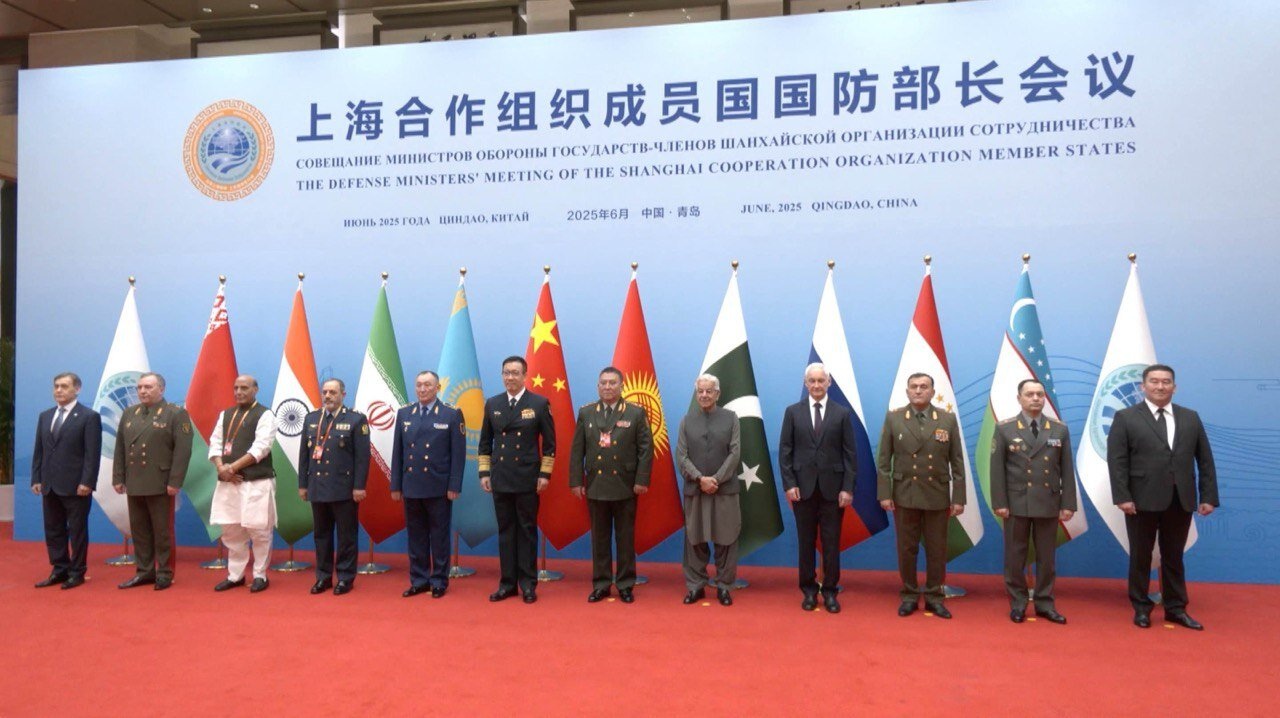
SCO Defense Ministers Meet in China

Against the backdrop of intensifying global conflicts, defense ministers from the ten member states of the Shanghai Cooperation Organization (SCO) convened this week in China’s eastern city of Qingdao, reaffirming their commitment to dialogue, multilateralism, and regional stability.

Hosted by Chinese Defense Minister Dong Jun, the annual SCO Defense Ministers’ Meeting on June 26 emphasized strategic coordination in the face of growing international uncertainty—particularly as tensions escalate in the Middle East and Eastern Europe.

During a bilateral meeting on June 25, Chinese Defense Minister Dong met with his Iranian counterpart Aziz Nasirzadeh, who is in China to attend the SCO gathering. Dong reaffirmed China’s support for Iran’s legitimate position and criticized unilateralism and hegemonic behavior, calling them major sources of global instability.  

“In a world undergoing profound changes, unilateralism, protectionism, and power politics are eroding the international order,” Dong said. “The defense departments of SCO member states must uphold founding principles of the SCO, deepen practical cooperation, and safeguard a peaceful environment for development.”  

In response, Minister Nasirzadeh thanked China for its understanding and support in the face of the recent aggression.  

“Iran has recently come under attack, and we are grateful for China’s just position. We hope China will continue to play a constructive role in preserving the ceasefire and easing regional tensions,” he said.

In a joint statement released on June 23, the SCO expressed serious concern over the recent escalation in the Middle East, strongly condemning the United States' military strike on Iran’s nuclear facilities, which the organization said violated international law, the UN Charter, and the SCO Charter, particularly the principle of non-use of force in international relations.  

“The attack on Iran’s sovereignty and territorial integrity has seriously undermined regional and global peace and stability,” the statement read, calling for the crisis to be resolved through political and diplomatic means.  

The meeting also saw defense chiefs from India and Pakistan share the same table for the first time since a military flare-up in Kashmir last month.

Belarus and Iran, the SCO’s newest full members, participated in the event for the first time in this capacity—highlighting the organization’s growing breadth and influence.  

Dong welcomed all attendees with a call for greater defense coordination under the Global Security Initiative proposed by Chinese President Xi Jinping, which promotes common, comprehensive, cooperative, and sustainable security.  

Xiao Bin, Deputy Secretary-General of the SCO Research Center at the Chinese Academy of Social Sciences, described the SCO as a rare example of a multilateral security platform that emphasizes non-alignment, non-confrontation, and consensus-based cooperation.  

“It plays a unique role in stabilizing the regional landscape, curbing destabilizing factors, and promoting peaceful dialogue in times of conflict,” Xiao said.

As the rotating chair, China has overseen a year of active defense diplomacy. According to Senior Colonel Zhang Xiaogang, spokesperson for China’s Ministry of National Defense, recent SCO events have helped build trust and amplify the organization’s collective voice on global security.  

“These meetings provided a vital platform for dialogue and consensus-building among all member states,” Zhang noted.  

The Qingdao meeting, held in a city symbolic for being where China first proposed the “SCO Community of Shared Destiny” in 2018, delivered a timely reminder of the group’s mission, to uphold peace, sovereignty, and shared development in an increasingly fragmented world.

As tensions mount across multiple regions, the SCO has emerged as a platform where strategic communication, mutual respect, and regional cooperation can still flourish.


Impact of Iran on resistance forces and people

The US-led Israeli aggression against Iran has imposed a complex landscape that will gradually become clearer. Iran has succeeded in preserving its sovereign gains, relying on a cohesive system of defensive strategies and indigenous capabilities that have exceeded the expectations of its enemies.

Despite the severe blows, and thanks to Iran’s military, security, diplomatic, and popular strength, Tehran has been able to show unprecedented deterrence that have inflicted unforeseen costs on its enemies.

This has been achieved through carefully considered operational performance that has efficiently confounded their calculations, while maintaining its constant readiness for any potential future surprise attack.

Tehran has avoided falling into the trap of depleting its strategic capabilities, which will establish more solid negotiating power in favor of the entire Axis of Resistance.

The legitimacy of the strategic vision of the Islamic Revolution, its institutions, and its alliances (not its arms, as the enemies promote) was strengthened, as it purified the Islamic popular consciousness and mood, which had been polluted by Western propaganda and fabricated nonsense.

The victory of the Islamic Revolution in Iran compensated for the setbacks suffered by the peoples of West Asia, particularly after Egypt’s deviation from the resistance front and its subsequent normalization with the Zionist regime.

Over four decades since the blessed Islamic revolution, Iran has been able to shake the foundation of the illegitimate Zionist entity. Thus, the project of David Ben-Gurion, one of the colonial Israeli entity’s founders, has collapsed.

This imperialist project was based on forging strategic alliances with peripheral states (Iran and Turkey) in order to restrain the surrounding states (Syria, Lebanon, Jordan, and Egypt). 

Since the 1990s, despite the heavy toll of the 1980-88 Iran-Iraq War, Tehran’s support for Hezbollah led to the May 2000 liberation, victory in the July 2006 war, and the successive victories of Gaza from 2008 to 2021, in addition to defeating the Takfiri project in 2017.

“A million Arabs are not worth a Jewish fingernail. We must stop the Iranian attack on Israel,” Jay Sullivan, the US senator and AIPAC member, wrote on X, making no distinction between Iranians and the Arabs, even though the imperialist project tried hard to present them as opposites. 

What Tehran has established as a firm principle is that accepting the so-called “peace” concessions, as proven by the experiences of Egypt, the PLO, Jordan, and some Persian Gulf sheikhdoms, only breeds more humiliation, submission, and degradation.

Despite the events that have followed the Al Aqsa Flood Operation - including the ongoing attacks on Gaza and Lebanon – and the fall of Damascus, Tehran demonstrated the cohesion and resilience of the resistance project, which some had imagined had collapsed irretrievably.

Most importantly, Iran has demonstrated its institutional depth, structural cohesion, and extremely solid foundation.

What our enemies dub as an Iranian “project” has been evident to the Iranian people and the peoples of the region. It has also been evident to the herds of colonial settlers as Tehran succeeded in undermining the trust between them and their fragile entity that failed to provide them with security throughout occupied Palestine.

In Lebanon, Italy took over command of UNIFIL from Spain in the presence of the head of the committee supervising the implementation of the ceasefire agreement, US General Michael Lenny, who attended despite the warning from the US spy den (the embassy) in Beirut to “take strict security measures” for fear of being targeted. 

Since assuming his position, succeeding General Jasper Jeffers, Lenny will chair a meeting of the committee (which has been suspended since March 11) to review the implementation of UN Resolution 1701.

Given the continued Israeli occupation of tens of thousands of meters of lands along the southern border, including the five points, UNIFIL’s most difficult challenge is whether and how its mandate will be renewed at the end of next August.

This is in addition to its military and civilian personnel and equipment, the value of the general budget, and, most importantly, the extent of its powers, which have not yet been decided. The Lebanese government has been preoccupied with condemning the legitimate Iranian response against the American air base in Qatar, rather than pursuing the renewal of UNIFIL’s mandate.

Meanwhile, the Lebanese Army has arrested one of the most prominent ISIS leaders “following a series of security surveillance and monitoring operations”, seizing in his possession “a large quantity of weapons and ammunition, in addition to electronic devices and equipment for manufacturing drones.”

The Lebanese Army clarified in the statement that “the detainee had assumed leadership of the organization in Lebanon after the arrest of his predecessor (who was appointed as a Caliphate of Lebanon) along with a large number of terrorists.

Impact of Iran’s legendary resilience on the Resistance forces and people


Khamenei claims victory over Israel

According to media reports, Iran’s Supreme Leader Ayatollah Ali Khamenei has said his country emerged victorious over Israel and “delivered a slap to America’s face” on Thursday.

The speech in a video broadcast marked Khamenei's first public comments since a US-brokered ceasefire was declared between the two countries following 12 days of conflict.

He told viewers that Washington had only intervened in the fighting because “it felt that if it did not intervene, the Israeli regime would be utterly destroyed.”

Khamenei said “US has achieved no gains from this war."

“The Islamic Republic was victorious and, in retaliation, delivered a slap to America’s face,” he said, in apparent reference to an Iranian missile attack on a US base in Qatar on Monday, which resulted in all rockets neutralized and no casualties.

Khamenei has not been seen in public since reportedly taking shelter in a secret location after the outbreak of the conflict on June 13, when Israel struck multiple military targets and nuclear facilities in Iran.

Following a massive US bombing attack last Sunday that struck Iran's main nuclear facility, Fordow, with bunker-buster bombs, Washington and President Donald Trump negotiated a ceasefire that came into effect on Tuesday.

Khamenei did release a video message last Sunday at the height of the conflict, and state-run media outlets announced he would make an appearance in a video message to his compatriots on Thursday.

The ayatollah also congratulated Iran "on the victory" over Israel in a post on X.

Khamenei downplayed the impact of the US strike on three of the country's nuclear sites, suggesting they had "failed to achieve anything significant".

This directly contradicts Donald Trump's claims that the US had "obliterated" Iran's nuclear program when 125 military aircraft targeted the sites of Fordo, Natanz and Isfahan.

Speaking at the Nato summit in the Netherlands on Wednesday, Trump rejected a Pentagon intelligence report that suggested the US had only set back Iran's program "by a few months".

Instead, Trump insisted that the nuclear sites in Iran were "completely destroyed" and accused the media of "an attempt to demean one of the most successful military strikes in history".

Standing alongside Trump at the Nato podium, Defense Secretary Pete Hegseth also dismissed the report, and argued that the evidence of what had been bombed "is buried under a mountain, devastated and obliterated".

And this was followed up by CIA director John Radcliffe, who later said there was "credible intelligence" Iran's nuclear program had been "severely damaged".

Iran's supreme leader said the US military action was never about nuclear issues or nuclear enrichment — but about "surrender".

Khamenei continued, saying that the Iranian people demonstrated their unity — sending a message "our people are one voice".

He said Trump called on Iran to "surrender", but his comments were “too big for the mouth of the president of the United States”.

"For a great country and nation like Iran, the very mention of surrender is an insult," Khamenei added.

He said Trump accidentally revealed a truth — that the Americans have been opposing the Islamic Republic of Iran from the very beginning.

He said Trump had made an “unusually exaggerated” account of what had taken place.

It was clear he needed to do it, said Khamenei, adding that anyone listening could tell the US were overstating things to distort the truth.

"We attacked one of the US’s key bases in the region, and here, they tried to downplay it," he said.

Khamenei's speech came a day after Iran’s parliament approved a bill to suspend cooperation with the UN’s nuclear watchdog, as politicians unanimously supported the move against the International Atomic Energy Agency (IAEA), according to Iranian state media.

The bill, which states that the Supreme National Security Council must authorize any future IAEA inspection, will need to be approved by the unelected Guardian Council to become law.

“The International Atomic Energy Agency, which refused to even marginally condemn the attack on Iran’s nuclear facilities, put its international credibility up for auction,” Parliament Speaker Mohammad Bagher Ghalibaf said on state television.

“The Atomic Energy Organization of Iran will suspend its cooperation with the IAEA until the security of our nuclear facilities is guaranteed,” he added.

Meanwhile, Iranian Foreign Ministry spokesperson Esmail Baghaei stated on Thursday morning that Tehran has a "right" to nuclear energy for peaceful purposes.

"Iran has the full right under Article 4 of the Nuclear Non-Proliferation Treaty to use nuclear energy for peaceful purposes, and it is determined to uphold that right under any circumstances," Baghaei said.

The US "must be held accountable for the aggression it committed against Iran in collusion with Israel," he added, claiming that the bunker buster strikes "destroyed diplomacy".