Friday, 3 January 2020

Trump administration justifies killing of Soleimani


Qassem Soleimani, Commander of Iran’s elite Quds Force, was killed in the US air strike in Baghdad, the attack was ordered by President Donald Trump.  His killing has instantly upped the military stakes in the region. Some believe that his killing was an adventurist step that will increase tensions throughout the region and make the world even more dangerous. Others believe that the incident opens the doors of the region to all possibilities, except peace and stability and United States will have to bear the responsibility for that. Let us review what the western media has to say.
According to media reports, Trump administration has justified killing of Soleimani as an act of self defense. This announcement came in response to the accusations that United States has violated international law and concerns raised by legal experts and a senior UN rights investigator.
According to Reuters, Republican and Democratic lawmakers dispute the wisdom of the attack. Some legal experts questioned whether Trump had the legal authority to target Soleimani on Iraqi soil without the permission of Iraq’s government, and whether it was legal under international and US law.
Iraq’s prime minister said Washington had with the attack violated a deal for keeping US troops in his country, and several Iraqi political factions united in a call for American troops to be expelled.
The UN Charter generally prohibits the use of force against other states but there is an exception if a state gives consent to the use of force on its territory. Legal experts said the absence of consent from Iraq makes it difficult for the United States to justify the killing.
Yale Law School professor Oona Hathaway, an international law expert, said on Twitter that the available facts “do not seem to support” the assertion that the strike was an act of self-defense, and concluded it was “legally tenuous under both domestic and international law.”
The Pentagon said targeting Soleimani was aimed at deterring “future Iranian attack plans,” while Trump said the Iranian general was targeted because he was planning “imminent and sinister” attacks on US diplomats and military personnel.
Robert Chesney, a national security law expert at the University of Texas at Austin School of Law, said the administration’s best argument on the UN Charter issue is self defense. “If you accept that this guy was planning operations to kill Americans, that provides the authority to respond,” he said.
Scott Anderson, a former legal adviser to the US Embassy in Baghdad under Trump’s predecessor, Barack Obama, said Trump’s justification so far under international law is questionable, but he could try to argue that the Iraqi government was either unwilling or unable to deal with the threat posed by Soleimani, giving the United States the right to act without Iraq’s consent.
Article 51 of the U.N. Charter covers an individual or collective right to self-defense against armed attack. The United States used the article to justify taking action in Syria against Islamic State militants in 2014. The US troops in Iraq had been fighting Islamic State, and about 5,000 troops remain, most of them in an advisory capacity.
A strategic framework agreement signed in 2008 between Washington and Baghdad called for close defense cooperation to deter threats to Iraqi “sovereignty, security and territorial integrity,” but prohibited the United States from using Iraq as a launching point for attacks on other countries.
Under historic norms of international law, a country can defend itself preemptively if it acts out of necessity and responds proportionally to the threat.
Agnes Callamard, the U.N. special rapporteur on extra-judicial executions, questioned whether the attack met this threshold.
The targeting of Soleimani “appears far more retaliatory for past acts than anticipatory for imminent self-defense,” she said. “Lawful justifications for such killings are very narrowly defined and it is hard to imagine how any of these can apply to these killings.”
Democratic lawmakers called on Trump to provide details about the imminent threat that he said Soleimani represented.
“I believe there was a threat, but the question of how imminent is still one I want answered,” Senator Mark Warner, the Democratic vice-chair of the Senate Intelligence Committee, told Reuters.
Other critics raised questions about Trump’s authority to kill Soleimani under US law, and whether he should have acted without first notifying Congress.
Legal experts noted that recent US presidents from both parties have taken an expansive view of their unilateral ability to preemptively engage in force, including through targeted killings, a view bolstered by executive branch lawyers in successive administrations.
In the case of Soleimani, the administration’s self-defense arguments may hinge on disclosing specific knowledge of his imminent plans to attack Americans.
Self-defense could allow the administration to act without having to first notify Congress or act under a prior congressional authorization for the use of military force, Chesney said.
Democratic lawmakers did not defend Soleimani, who US officials have said is responsible for the deaths of hundreds of Americans, but they called on Trump to consult with Congress going forward.
“This administration, like all others, has the right to act in self-defense,” said Rep. Elissa Slotkin, a former Central Intelligence Agency analyst who worked in Iraq focusing on Iranian-backed militias. “But the administration must come to Congress immediately and consult.”


Thursday, 2 January 2020

US warns of preemptive attack against forces allegedly backed by Iran


The predictable result of the Trump administration’s reckless bluster, escalation and miscalculation in the Middle East is that the super power is now hurtling closer to an unauthorized war with Iran. America has the surprising audacity of attributing to Iran the protests of the Iraqi people against (Washington’s) savage killing of at least 25 Iraqis.
The embassy incident came seven years after the 2012 attack by armed militants on the US diplomatic compound in Benghazi, Libya, that resulted in the death of the US Ambassador and three other Americans and led to multiple congressional investigations.
The unprecedented attack on an American diplomatic mission in Iraq marked a sharp escalation of the proxy conflict between the United States and Iran - both influential players in the country - and plunged US relations with Iraq to their worst level in years.
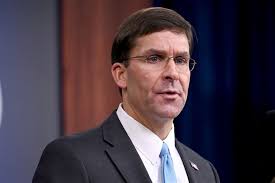
Mark Esper, US Defense Secretary said on Thursday that there were indications Iran or the forces it backs may be planning additional attacks and said it was possible the United States might have to take preemptive action to protect American lives.
“There are some indications out there that they may be planning additional attacks, that is nothing new ... we’ve seen this for two or three months now,” Esper told reporters.
“If that happens then we will act and by the way, if we get word of attacks or some type indication, we will take preemptive action as well to protect American forces to protect American lives.”
Iranian-backed demonstrators who hurled rocks at the U.S. embassy in two days of protests withdrew on Wednesday after Washington dispatched extra troops.
Donald Trump, US President, who faces a re-election campaign in 2020, accused Iran of orchestrating the violence. He threatened on Tuesday to retaliate against Iran but said later he did not want war.
The unrest outside the US embassy in Baghdad followed US air raids on Sunday against bases of the Tehran-backed Kataib Hezbollah group. Washington said the air strikes, which killed 25 people, were in retaliation for missile attacks that killed a US contractor in northern Iraq last week.
The protests marked a new turn in the shadow war between Washington and Tehran playing out across the Middle East.
“The game has changed and we are prepared to do what is necessary to defend our personnel and our interests and our partners in the region,” Esper said.
During the same press briefing, Chairman of the Joint Chiefs of Staff Mark Milley said there had been a sustained campaign by Kataib Hezbollah against US personnel since at least October and the missile attack in northern Iraq was designed to kill.
“Thirty-one rockets aren’t designed as a warning shot, that is designed to inflict damage and kill,” Milley said.


Tuesday, 31 December 2019

Motives behind US air strikes in Iraq and Syria


The fighter jets of United States targeted several bases of the Iraqi popular forces of Hashd al-Shaabi at border with Syria on Sunday evening. In a statement, the US defense secretary confirmed the attacks. Now the question is, which objectives had the US wanted to achieve from the attacks?
There is growing perception that the US was not comfortable with the consolidation of relationship between Iraq and Syria, especially in security and economic fields. Therefore, Washington wanted to seal Iraq-Syria common borders and passageways by targeting military positions in Iraq and Syria as well as providing support for the existing terrorists and creating fresh terrorist group.
Keeping the terrorist groups protected and providing backup for them seems to be the main objective of the US  after a number of reports hinted towards relocation of terrorists from Syria into Iraq or vice versa. In the meantime, the US has raided the Iraqi army several times to provide support for the terrorist groups in the country. 
Certainly, weakening Iraq and turning it into a crisis-hit country is aimed at providing the ground for the US to impose its will on Baghdad. Weakening the Iraqi popular forces and damaging relations and cooperation between the country’s army and the popular forces are also among the main objectives of such plots. 
Other dimensions of the US recent plot against Iraq can be mentioned as spreading chaos and turning peaceful protests of the Iraqis into violence, destabilizing Iraq’s political situation by interfering in the trend of forming the country’s new government, weakening Iraq’s security forces through conducting attacks on the Army centers and Hashd al-Shaabi’s bases and cutting Iraq’s ties with its neighboring countries including with Iran.
The new US plot is also aimed at deviating public opinion from critical situation of the Zionist regime of Israel as well as appeasing the Zionist lobby to continue supporting Donald Trump who is facing the congress impeachment.
By acts, the US proves it is the number one supporter of terrorism. Washington’s claim of campaign against terrorism is only a deception that is why their claimed military coalitions in the Persian Gulf and in the Bab al-Mandab Strait have brought about nothing but enhancing terrorism.   
The US has not been a savior but it has been disruptor of the region’s security and stability. The secret trips of the US officials to Iraq have certainly roots in their fear from the Iraqis’ rage against Americans’ crisis-making behaviors.
Widespread supports of popular and political groups as well as the country’s religious authorities for Hashd al-Shaabi against the US aggressive policies shows nationwide trust of Iraqis in the resistance forces which in turn shows failure of the White House’s anti-resistance project.  

Monday, 30 December 2019

Iran Russia China joint naval drill in Sea of Oman


Naval forces from Iran, Russia and China started a large-scale maritime exercise in the northern part of Indian Ocean and Sea of Oman on Friday, 27th December 2019.The joint exercise is being viewed by some analysts as a show of power and solidarity between Iran, China and Russia. The exercise, named “Marine Security Belt”, will last for four days and cover 17,000 square kilometers and consist of "various tactical exercises"
Earlier, speaking at a news conference on Wednesday, Iranian Armed Forces Brigadier General Abolfazl Shekarchi said it was important and vital that security should be established in Indian Ocean and Sea of Oman. Indian Ocean and Sea of Oman are among the world's key trade routes and many countries commute in the (two) regions and therefore establishing security there is important and vital, said Shekarchi.
Iranian Foreign Minister Mohammad Javad Zarif said on Friday that the joint military exercises show that Iran and its partners are committed to secure vital waterways. “Our joint military drills in Oman Sea/Indian Ocean with Russian and Chinese partners make clear our broader commitment to secure vital waterways,” Zarif added. Iran has been insisting that it is ready to work with its neighbors on the southern shores of the Persian Gulf to secure maritime trade in the region based on the Hormuz peace initiative. “Iran has long stated its readiness to work with its neighbors to secure the Persian Gulf.
Since the victory of the Islamic Revolution in Iran in 1979, it is the first time that the country has staged such a large-scale drill participated with two huge naval powers in the world. Certainly those countries share security, economic, political, and defense interests and try to restore collective security in the region. Reinvigoration of international maritime trade, countering piracy, exchange of information and experiences in various fields including maritime rescue and relief are among the main objectives of the drill.
Rear Admiral Tahani said peace, friendship and sustainable security under collective unity and cooperation are the main messages of the current naval drill. The message of this exercise is peace, friendship and lasting security through cooperation and unity … and its effect will be to show that Iran cannot be isolated.
China has sent a guided-missile destroyer to the four-day drills, which it called a "normal military exchange" between the three armed forces. It is not necessarily connected with the regional situation. China has close diplomatic, trade and energy ties with Iran, which has friendly ties with Russia.
Russia had sent three ships from its Baltic Fleet - a frigate, a tanker, and a rescue tug boat - to take part in the drills. It is believed that Russia is participating for the first time in such drills, being held in such a format.
The drills are being held at a time that the United States is resorting to every ploy to pressure Iran and isolate it in the world.  It sends a clear signal to the United States that the Iran issue should be addressed through negotiations based on the previous deal rather than military actions. The US should stop fanning the flames.
Certain quarters say that the drill was in response to recent US maneuvers with its regional ally Saudi Arabia. The trilateral drills are the first of its kind and being held at a time when Iran is facing unprecedented sanctions from the US. The joint drills are likely to be perceived as provocative by Washington.