Saturday, 12 November 2022

China and US face changing power dynamics

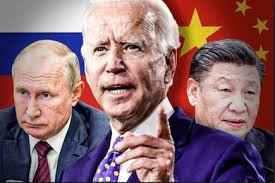
According to the South China Morning Post, political events in China and America have given rise to new power dynamics. While the 20th Chinese Communist Party congress has solidified the policies of President Xi Jinping, the midterm election has further muddied the already chaotic political waters in the United States.

With an already shaky hold on some of the partners that he is courting, Biden faces a weaker position in terms of congressional support, and it remains to be seen whether that will further undermine his alliance building.

The austere choreography of Beijing’s twice-a-decade leadership reshuffle contrasted with the bruising political campaigns of the US midterms, which have yet to reveal how much power Republicans will have starting in January and what that will mean for President Joe Biden’s China policy or Indo-Pacific Strategy.

While the world more or less knows what to expect from Beijing, those with a stake in the success or failure of Biden’s effort to build a strategic environment that makes it tough for China will be watching closely for indications that the new US political landscape will undermine it. 

With that in mind, now might be a good time to take stock of the alliances and partnerships that Biden has built or bolstered during his first two years in office, a network of overlapping groups and policies so sprawling that they sometimes come into conflict with each other.

One of the most recent successes on this front was Canada’s decision to join Biden’s Indo-Pacific Economic Framework (IPEF), an initiative that was initially portrayed by some as a poor substitute for the Comprehensive and Progressive Trans-Pacific Partnership and came under attack for its lack of a market-access component.

After a more tenuous approach to countering Beijing compared with Washington, Ottawa has taken more pointed steps that align with the Biden administration’s efforts to chip away at China’s dominance in the production of key industrial materials needed to manufacture electric vehicles and other products that are essential to meeting the world’s carbon-reduction targets.

Just this month, Canadian government ordered three Chinese companies to divest from a handful of lithium miners based in the country, after introducing tougher rules on foreign investments in the nation’s critical minerals sectors. Days later, Canadian Foreign Minister Melanie Joly accused China of adopting an increasingly disruptive stance on the world stage as she referenced her government’s eagerly awaited Indo-Pacific strategy.

Biden has also drawn closer to the European Union through the US-EU Trade and Technology Council established last year in a bid to reduce its members’ shared reliance on China’s manufacturing juggernaut, while strengthening their respective domestic supply chains involving strategic technologies.

As with NATO and the G7, Russia’s war on Ukraine managed to give that alliance an additional sense of urgency. The group announced during their second formal gathering, just weeks after the Kremlin launched its attack that trade in technologies can be pivotal to the ability of autocratic countries to implement authoritarian policies, perpetrate human rights violations and abuses, which analysts said could be used as a justification for further restrictions on certain technology exports to China.

In addition to the interest that China’s neighbours in Asia have expressed in the IPEF, Biden has also had a degree of success in shoring up military ties with the Philippines, whose relations with Washington on defence have not been as robust as they have been with Japan and South Korea. Citing concerns about China’s military modernization, US Deputy Defence Secretary Kathleen Hicks confirmed the Pentagon’s objectives on this front earlier this year.

During a meeting with his American counterpart Lloyd Austin, Philippine Defence Secretary Delfin Lorenzana said then-president Rodrigo Duterte had decided to renew the 23-year-old Visiting Forces Agreement, which many expected Manila would opt to scrap after Duterte abrogated the accord in 2020.

The Quadrilateral Security Dialogue, also known as the Quad, with India, Japan and Australia – revived and invigorated by Biden – also appears to strengthen Washington’s hand with respect to the country that it has identified as its most consequential geopolitical challenge.

The Quad has also taken on more significance owing to Russia’s aggression against Ukraine and Biden’s frustration over Beijing’s refusal to condemn the war. However, a trip by India’s foreign minister to Moscow just days ago underscored how little control the US leader may have in nurturing new alliances.

Subrahmanyam Jaishankar hailed New Delhi’s strong and steady relationship with Moscow lately and declared India’s intention to continue to buy Russian oil, disregarding US appeals to allies and partners to isolate Russia from the global markets.

Launched in Biden’s first year in office, Washington’s new military alliance with Britain and Australia, or Aukus, also presents uncertainties over his efforts to counter Beijing’s more assertive military posture.

While Aukus will deliver advanced nuclear submarine technology to Canberra, it has also enraged the prime minister of the Solomon Islands, Manasseh Sogavare, helping to push the island nation closer to China after it switched diplomatic recognition from Taipei to Beijing. 

In a United Nations speech that echoed Beijing’s rhetoric, Sogavare said that his country had been maligned over its closer relationship with China to the point of intimidation.

As all of this plays out, Republicans are preparing to take control of the House of Representatives, where California’s Kevin McCarthy will most likely become the chamber’s leader. In an indication of how cooperative McCarthy will be with the president of China, he has already dismissed the Biden administration’s effort to investigate the origins of Covid-19 with a vow to start a new probe.

Masto victory: Democrats to control Senate

Democratic US Senator Catherine Cortez Masto has won re-election in Nevada on Saturday; a victory that guarantees the Senate will be controlled by Democrats in 2023.

Cortez Masto defeated Republican challenger Adam Laxalt, a former state attorney general who was endorsed by former President Donald Trump.

With Masto's victory on the heels of Democratic Senator Mark Kelly winning re-election in Arizona late on Friday, Democrats now control 50 Senate seats.

That is enough to cement Democrats' control of the Senate in 2023-24, as Democratic Vice President Kamala Harris can break ties in the 100-member chamber, securing victories for President Joe Biden.

If Democratic Senator Raphael Warnock were to win the December 06, 2022 Georgia runoff election against Republican challenger Herschel Walker, that would expand Democrats' majority to 51-49. That, in turn, would give Democrats an additional edge in passing a limited number of controversial bills that are allowed to advance with a simple majority of votes, instead of the 60 needed for most legislation.

Currently, Democratic Senators Joe Manchin in West Virginia and Kyrsten Sinema in Arizona are swing votes who have blocked or delayed some of Biden's major initiatives, including expansions of some social programs.

But with 51 Democratic seats in the Congress that convenes next year, Manchin's and Sinema's influence could be slightly diluted.


US Election: Military-Industrial-Congressional Complex Wins Again

With Veterans Day in mind, if one is asked to comment on the 2022 election outcome, the reply is, the winner in 2022 is the same as has always been, the military-industrial-congressional complex. It is a sad result to contemplate with Veterans Day looming.

In this election cycle, people have heard nothing about peace; have heard nothing about strengthening and preserving democracy by downsizing our military and imperial presence around the globe. Not from Democrats and Republicans.

When both political parties pose as pro-military, when both are pro-war, when both are enablers of record-high Pentagon spending, when both act as if a new cold war with China and Russia is inevitable, do election results even matter? No matter which party claims victory, the true victor remains the military-industrial-Congressional complex.

To paraphrase Joe Biden, nothing fundamentally changed in the 2022 elections when it comes to colossal military spending, incessant wars and preparations for the same and non-stop imperialism around the globe. There is no new vision for lower Pentagon spending, for fewer wars and weapons exports, and for a smaller, less domineering, imperial mission.

As General and President Dwight D. Eisenhower warned in 1961, the military-industrial-Congressional complex represents a disastrous rise of misplaced power that is profoundly anti-democratic. Collectively, we’ve failed to heed Ike’s warning. The result has been one unnecessary and disastrous war after another, even as democracy in America withers.

The Vietnam War—disaster. The Iraq War—disaster. The Afghan War—disaster. The War on Terror—disaster. Even the war US ostensibly won, the Cold War against the USSR, is now apparently about to be refought. May be the US needs to refight the Cold War which it won thirty years ago so that it can lose that one too.

With the Democrats doing somewhat better than expected at the polls, war business should continue to grow in Washington, D.C. Most political commentators seem to think this is a good thing, when they think about it at all. Few seem to recall Ike’s warning that a military establishment of vast proportions is antithetical to democracy.


Friday, 11 November 2022

Pakistan Auto Industry a victim of limited foreign exchange availability

State Bank of Pakistan (SBP) has set a quota on imports for car assemblers, assigning 50%/60%/70% of the average import during the March-June period for July/August/September, respectively.

The 70% quota has continued for the time being, although OEMs are pushing for the government to increase the quota. Consequently, PSMC has had to pay PKR2.2 billion in port charges as imported kits could not be cleared.

The local auto part manufacturers have recently stated their fears of going bankrupt given the lackluster pricing from OEMs. Unless the margins incorporated in the pricings are unfrozen, production lines for these part manufacturers may come to a halt, adversely affecting the localized supply for Assemblers.

On the flipside, in case the pricings are revised, already depressed margins for OEMs may be further pressured due to increasing Cost of Sales. On a QoQ basis, sales of passenger cars and LCVs have dropped by 53% in 1QFY23 as compared to the previous quarter.

INDU had run its production plant for 9 days in July, with two weeks off in August and September each. The same negative impact of delayed deliveries is experienced by other OEMs, with PSMC shutting down its plant for 25 days between August and October along with closure of bookings.

HCAR showed better inventory management, not having to shut down plants in Q1, although the company has closed down its plant for 12 days in October. In August, auto assemblers have hiked prices by 15% at an average from previous revision. This is on top of the 15% hikes experienced in the last quarter.

The reduction in demand for auto-financing can be expected to impact INDU lesser, as it remained protected compared to HCAR and PSMC, with merely 20% of sales through auto-financing previously, lesser compared to 35-45% of the other two.

As disposable incomes remain stagnant and auto-financing getting out of reach, coupled with exuberant hikes in prices in the past 5 months, analysts expect demand for automobiles to decline substantially in FY23.

Pakistan: E&P companies post windfall profit

According to a report by Pakistan’s leading brokerage house, AKD Securities, the Exploration & Production (E&P) sector has reported phenomenal earnings for 1QFY23. The sector’s profit after tax was reported at PKR100.8 billion—the highest in its history. 

The sector’s earnings grew 55%YoY, with favorable macros driving earnings growth this quarter.  Net sales were reported at PKR226.6 billion for the quarter, higher by 13%QoQ and 54%YoY. This despite a drop in Oil/Gas production, but a weak PKR fueled topline growth. 

Exploration expenses in the final quarter of last year were at PKR26.6 billion, with the giant’s share dropping in PPL’s lap, with the Company reporting PKR11 billion in dry well costs. In 1QFY23, the exploration expenses of the sector were stated at PKR9.2 billion, lower by 65%QoQ, due to the absence of any substantial dry wells. 

On a company wise basis, the greatest sequential growth in profitability was posted by PPL, with net profit growing rising to PKR26.3 billion for the quarter. Trade Debts of OGDC and PPL were reported at PKR491 billion and PKR401 billion at the end of the quarter, respectively, increasing by PKR34 billion and PKR35 billion from the earlier quarter. 

The E&P sector provides investors with an exchange rate hedge, with the prospects of the sector having been muddied by mounting trade debts for the larger companies. Hence, within the sector, analysts like MARI and POL due to the relatively low exposure to the circular debt menace.

Pakistan Stock Exchange index up 2.95%WoW

As the political noise in the country eased off considerably, the benchmark index of Pakistan Stock Exchange (PSX) posted a robust uptick. The index moved up by 1,237 points during the week ended on November 11, 2022 to close at 43,093 points, up 2.95%WoW.

The uptick in index was witnessed amid healthy participation with the weekly average daily traded
volumes also jumping by 8.8%WoW to settle around 306.4 million shares, as opposed to 281.5 million shares witnessed last week. Stability also returned in the foreign exchange market during the week with PKR holding its ground against US$ at 221.6, appreciating by 20bpsWoW.

The newfound stability in PKR came amid a hefty depletion in country's official foreign exchange reserves which declined by US$956 million as the country made repayments on its international debt.

Major news flows during the week were: 1) SBP taking various steps to contain foreign exchange outflow, 2) Cabinet approving US$900 million escrow account for Reko Diq in March next year, 3) Bank Alfalah expressing plan to buy back 200 million shares, 4) DFML to start assembling LCVs, 5) first quarter fiscal deficit soaring to one percent of GDP from 0.7% of GDP, 6) Cement, CNG, Fertilizer sectors to face gas shortage in winter and 7) FBR Chairman ruling out any new tax amnesty.

The top performing sectors were: Leasing, Vanaspati and Allied, E&Ps, Refineries and Technology, while the least favorite sectors were: Miscellaneous, Sugar, Textiles, Leather and Tanneries (-0.8%WoW) and Woollen.

Stock-wise, top performers in the KSE-100 Index were PGLC, TRG, FABL, PPL and BAFL, while laggards were: PSEL, SHFA, SCBPL, ILP and FFBL. To five volume leaders for the week were WTL, HASCOL, CNERGY, DFML and FFL.

Flow-wise, Mutual Funds and Banks were the largest buyers in the market during the week, with net buys of US$3.6 million and US$3.0 million respectively. While Foreigners and Insurance Companies were major sellers,
with the cumulative net sells of US$4.7 million and US$6.0 million respectively. The foreign outflow was largely concentrated in sectors namely Banks (US$5.31 million) and Technology (US$1.05 million).

After a relatively stable week for the currency, PKR may yet again come under pressure as foreign currency reserves posted a spectacular decline during the
week, while the inward remittances also slowed down significantly, falling by 9%YoY during October 2022.

On the political front, the things may start heating up once again as country's largest political party starts its
long march once again. Both these factors may yet again prove to be market dampeners and the resurgence that the market showed during this past week may fizzle out once again and the index may see a renewed selling pressure.

Investors are advised to maintain trading positions only and refrain from building and holding long positions in the market.

Thursday, 10 November 2022

Russia-China trade on the rise

Days before Putin ordered his troops into Ukraine, President Joe Biden and US allies warned that an invasion would result in devastating sanctions and crippling costs. By summer end, some 30 countries had imposed various forms of sanctions on Russia’s energy and financial sectors, as well as on Russia’s ability to import semiconductors and key technology components.

Despite Putin’s claims that Western economic restrictions and penalties have had little impact, evidence suggests otherwise. Making transactions has become more difficult, supplies of important goods have been much more limited, and the ability for many Russian businesses and businesspeople to move through overseas commercial centers, has become harder. Some 1,200 foreign companies have either sharply reduced operations in Russia or left there altogether.

But many other countries have chosen not to join the sanctions effort, and some seem to view the invasion—complete with atrocities and veiled threats of strategic nuclear weapons—as a business opportunity.

According to Chinese customs data, its bilateral trade with Moscow grew 31% in the first eight months of 2022. In July, China imported US$10 billion worth of goods from Russia, an increase of 49.3% from July 2021. China relies heavily on Russia for oil imports, with crude petroleum making up about 48.3% of total Russian imports to the country. Meanwhile, Russia primarily leans on China for electronics such as broadcasting equipment and computers, which make up about 14% of Chinese imports to Russia.

To be clear, close economic ties between Russia and China aren’t anything new. Since 2014, China (coincidentally, the year Russia illegally invaded and began occupying Crimea) China has remained Russia’s largest trading partner, while Russia is China’s fourteenth largest trading partner. China’s determination not to join in sanctions has amplified Russia’s dependence on what China’s markets and financial systems offer. 

When Xi and Putin met to discuss China-Russia relations on September 15, 2022 during the summit of the Shanghai Cooperation Organization, it was the first time the leaders met since they established a “no limits” relationship shortly before Putin’s invasion.

While China watchers noted Putin’s admission that China had questions about the war in Ukraine, he still exuded confidence in China-Russia relations as a strategic, comprehensive partnership with expectations for the alliance to deepen bilaterally and internationally.

With news of battlefield setbacks reaching domestic audiences in Russia, President Putin will likely be more sensitive than ever about any complaints by Russian citizens about food shortages or daily economic hardships.

If more countries were to join the US and its allies in imposing sanctions, one wonders how long Putin could maintain his current special military operation. Given Russia’s increased reliance on Chinese trade, what would happen if China were one of those countries?