Friday, 24 September 2021

United States supports Iron Dome funding for Israel

The US House of Representative passed legislation on Thursday to provide US$ one billion to support Israel’s Iron Dome missile defense system.

The standalone bill to ensure the Iron Dome funding passed handily on a bipartisan basis, 420-9, with two Democrats voting present. Eight liberal Democrats and one Republican voted in opposition.

The debate over the Iron Dome funding once again laid bare the internal Democratic divisions over Israel, which have repeatedly flared since they took over the House majority two years ago.

Those tensions flashed on the House floor Thursday as Rep. Rashida Tlaib, the lone Palestinian American member of Congress, spoke out against the Iron Dome funding.

“We cannot be talking only about Israelis’ need for safety at a time when Palestinians are living under a violent apartheid system,” Tlaib said, calling the Israeli government an apartheid regime.

“We should also be talking about Palestinian need for security from Israeli attacks,” she said. 

Rep. Ted Deutch, who is Jew, subsequently abandoned his prepared remarks and angrily blasted Tlaib for having besmirched our ally.

“I cannot, I cannot allow one of my colleagues to stand on the floor of the House of Representatives and label the Jewish democratic state of Israel an apartheid state. I reject it,” Deutch said.

The Senate is expected to consider the standalone Iron Dome funding bill at a later time.

Thursday, 23 September 2021

United States paving way for export of Iranian fuel to Afghanistan

Reportedly, the US administration is reviewing waiver of 2018 sanctions, which allowed Afghanistan to purchase Iranian gasoline and diesel.

According to the details a State Department spokesperson told London-based Middle East Eye online news outlet that the waiver put in place by former president Donald Trump's administration remains under active review after the overthrow of the Afghan government last month.

An amendment to repeal a part of the waiver reached the House Foreign Relations Committee last month but was blocked by the Committee Chairman Gregory Meeks.

According to Alex Zerden, who led the Treasury Department's office at the US embassy in Kabul from 2018 to 2019, the sanctions waiver on Iranian fuel exports to Afghanistan was intended at the time to protect Kabul even as Washington was pushing ahead its maximum pressure campaign against Tehran. 

“There were real concerns about Iran sanctions harming Afghanistan's economy and a waiver to import Iranian fuel was seen as crucial,” Zerden noted.

Trump left the 2015 Iran nuclear deal, officially known as the Joint Comprehensive Plan of Action (JCPOA) in 2018 and reimposed the sanctions on Tehran that had been lifted.

Zerden said the 2018 waiver on Iranian fuel sales to Afghanistan was intended to allow fuel traders to skip the sanctions imposed on Tehran, but not Taliban sanctions.

Taliban have already been subject to a range of US sanctions under an executive order enacted after the 9/11 attacks.

Howard Shatz, a senior economist at the Rand Corporation, said that even if Washington wanted to enforce the sanctions, it could prove difficult. “We don't have a lot of leverage with Iran and Afghanistan,” he said.

Zerden said, "Enforcing violations of sanctions would be difficult because this occurs outside formal financial channels." 

The fuel sales take place in cash at the Iranian-Afghan border. Most of the transactions occur through Afghanistan's informal Hawala banking system.

The main Iranian fuel exports to Afghanistan are gasoline and diesel. Iran exported about 400,000 tons of fuel to its eastern neighbor from May 2020 to May 2021, according to a report published by PetroView, an Iranian oil and gas research and consultancy platform.

Iranian fuel flows have been vital to Afghanistan in the last few years, according to traders and an Afghan Government report.

Between March 2020 and March 2021, Iran accounted for US$367 million of imports, mostly fuel, according to the report compiled by the Afghan Ministry of Finance, chambers of commerce, and data from private enterprises.


Wednesday, 22 September 2021

Meeting of Foreign Ministers of SAARC countries scheduled for 25th September cancelled

A meeting of foreign ministers of South Asian Association for Regional Cooperation (SAARC) countries, scheduled on Saturday, 25th September 2021 in New York, has been cancelled.

It is being stated by certain quarters that Pakistan wanted the Taliban to represent Afghanistan in the SAARC meet.

India along with some other members objected to the proposal and due to lack of consensus or concurrence, the meeting has to be cancelled.

Nepal is the host of the meeting, which is annually held on the sidelines of the United Nations General Assembly.

An official letter sent by the SAARC secretariat to the foreign ministries of the eight countries stated it received a note verbal or unsigned diplomatic correspondence from Nepal’s foreign ministry that stated the informal meeting of foreign ministers will not take place because of the lack of concurrence from all member states.


Sovereign Palestinian State: Best option for maintaining peace in Middle East

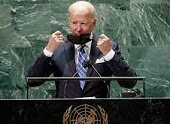
US President Joe Biden said on Tuesday that a sovereign and democratic Palestinian state is the best way to ensure Israel's future. “We must seek a future of greater peace and security for all people of the Middle East,” Biden said in a speech at the UN General Assembly.

“The commitment of the United States to Israel's security is without question and our support for an independent Jewish state is unequivocal,” he said.

“But I continue to believe that a two-state solution is the best way to ensure Israel's future as a Jewish democratic state, living in peace alongside a viable, sovereign and democratic Palestinian state,” he said.

“We're a long way from that goal at this moment but we should never allow ourselves to give up on the possibility of progress.”

The US will help resolve crises from Iran to the Korean Peninsula to Ethiopia, Biden told the annual UNGA gathering.

The world faces a “decisive decade”, Biden said, one in which leaders must work together to combat a raging coronavirus pandemic, global climate change and cyber threats. He said the US will double its financial commitment on climate aid and spend $10 billion to fight hunger.

Biden did not ever say the words “China” or “Beijing” but sprinkled implicit references to America's increasingly powerful authoritarian competitor throughout his speech, as the two nations butt heads in the Indo-Pacific and on trade and human rights issues.

He said the US will compete vigorously, both economically and to push democratic systems and rule of law.

“We'll stand up for our allies and our friends and oppose attempts by stronger countries to dominate weaker ones, whether through changes to territory by force, economic coercion, technical exploitation or disinformation. But we're not seeking — I'll say it again — we are not seeking a new Cold War or a world divided into rigid blocs,” Biden said.

Biden came to the UN facing criticism at home and abroad for a chaotic US withdrawal from Afghanistan that left some Americans and Afghan allies still in that country and struggling to get out.

His vow for allied unity is being tested by a three-way agreement among the US, Australia and Britain that undermined a French submarine deal and left France feeling stabbed in the back.

“We've ended 20 years of conflict in Afghanistan and as we close this era of relentless war, we're opening a new era of relentless diplomacy,” Biden said.

He vowed to defend vital US national interests, but said that “the mission must be clear and achievable,” and the American military “must not be used as the answer to every problem we see around the world”.

Biden, a Democrat, hoped to present a compelling case that the US remains a reliable ally to its partners around the world after four years of America First policies pursued by his Republican predecessor Donald Trump.

UN Secretary General Antonio Guterres, who begins a second five-year term at the helm of the world ,warned earlier of the dangers of the growing gap between China and the US, the world's largest economies.

“I fear our world is creeping towards two different sets of economic, trade, financial and technology rules, two divergent approaches in the development of artificial intelligence — and ultimately two different military and geopolitical strategies,” Guterres said.

“This is a recipe for trouble. It would be far less predictable than the Cold War,” Guterres said.

Tuesday, 21 September 2021

Chinese President’s most audacious geopolitical bet

A head-spinning series of seemingly disparate moves over recent months add up to nothing less than a generational wager that Chinese President, Xi Jinping  can produce the world’s dominant power for the foreseeable future by doubling down on his state-controlled economy, party-disciplined society, nationalistic propaganda, and far-reaching global influence campaigns.

With each week, Xi raises the stakes further, from narrowing seemingly mundane personal freedoms like karaoke bars or a teenager’s permitted time for online gaming to three hours weekly to the multi million US dollar investor hit from his increased controls on China’s biggest technology companies and their foreign listings.  

It is only in the context of Xi’s increased repressions at home and expanded ambitions abroad that one can fully understand Australian Prime Minister Scott Morrison’s decision this week to enter a new defense pact, which he called “a forever agreement,” with the United States and the United Kingdom.

Much of the news focus was either on the eight nuclear-powered submarines that Australia would deploy or the spiraling French outrage that their own deal to sell diesel submarines to Australia was undermined by what French officials called a “betrayal” and a “stab in the back” from close allies. France went so far as to recall its ambassador to the United States for the first time in the history of the NATO alliance.

All that noise should not distract from the more significant message of the ground-breaking agreement. Prime Minister Morrison saw more strategic advantage and military capability from the US-UK alignment in a rapidly shifting Indo-Pacific atmosphere, replacing his previous stance of trying to balance US and Chinese interests.

“The relatively benign environment we’ve enjoyed for many decades in our region is behind us,” Morrison said on Thursday. “We have entered a new era with challenges for Australia and our partners.”

For China, that new era has many faces: a rapid rollback of economic liberalization, a crackdown on individual freedoms, an escalation of global influence efforts and military buildup, all in advance of the 20th national party congress in October 2022, where Xi hopes to seal his place in history and his continued rule.

Former Australian Prime Minister Kevin Rudd, one of the world’s leading China experts, points to Xi’s “bewildering array” of economic policy decisions in a recent speech as president of the Asia Society.

They started last October with the shocking suspension of Alibaba financial affiliate Ant Group’s planned initial public offering in Hong Kong and Shanghai, clearly aimed at Alibaba co-founder Jack Ma. Then in April, Chinese regulators imposed a $3 billion fine on Alibaba for “monopolistic behavior.”

In July, China’s cyber regulator removed ride-hailing giant Didi from app stores, while an investigative unit launched an examination of the company’s compliance with Chinese data-security laws.

Then this month, China’s Transport Ministry regulators summoned senior executives from Didi, Meituan and nine other ride-hailing companies, ordering them to “rectify” their digital misconduct. The Chinese state then took an equity stake in ByteDance, the owner of TikTok, and in Weibo, the micro-blogging platform.

Xi was ready to accept the estimated US$1.1 trillion cost in shareholder value wiped from China’s top six technology stocks alone between February and August. That doesn’t factor in further losses among the education, transportation, food delivery, entertainment and video gaming industries.

Less noticed have been a dizzying array of regulatory actions and policy moves whose sum purpose appears to be strengthening state control over, well, just about everything. 

“The best way to summarize it,” says Rudd, “is that Xi Jinping has decided that, in the overall balance between the roles of the state and the market in China, it is in the interests of the Party to pivot toward the state.” Xi is determined to transform modern China into a global great power, “but a great power in which the Chinese Communist Party nonetheless retains complete control.”

That means growing controls as well over the freedoms of its 1.4 billion citizens.

Xi has acted, for example, to restrict the video gaming of school-aged children to three hours a week, and he has banned private tutoring. Chinese regulators have ordered broadcasters to encourage masculinity and remove “sissy men,” or niang pao, from the airwaves. Regulators banned “American Idol”-style competitions and removed from the internet any mention of one of China’s wealthiest actresses, Zhao Wei.

“The orders have been sudden, dramatic and often baffling,” wrote Lily Kuo in the Washington Post. Jude Blanchette of the Center for Strategic and International Studies says, “This is not a sector-by-sector rectification; this is an entire economic, industry and structural rectification.”

At the same time, President Xi has launched a push to share the virtues and successes of the Chinese authoritarian model with the rest of the world. 

“Beijing seeks less to impose a Marxist-Leninist ideology on foreign societies than to legitimate and promote its own authoritarian system,” Charles Edel and David Shullman, the recently appointed director of the Atlantic Council’s new China Global Hub, wrote in “Foreign Affairs.” “The CCP doesn’t seek ideological conformity but rather power, security, and global influence for China and for itself.”

The authors detail China’s global efforts to not remake the world in its image, but rather “to make the world friendlier to its interests — and more welcoming to the rise of authoritarianism in general.”

Those measures include “spreading propaganda, expanding information operations, consolidating economic influence, and meddling in foreign political systems” with the ultimate goal of “hollowing out democratic institutions and norms within and between countries,” Edel and Shullman write.

Within President Xi’s bold bet lie two opportunities for the US and its allies.

The first is that Xi, by overreaching in his controls at home, will undo just the sorts of economic and societal liberalization China needs to succeed. At the same time, the world’s democracies, like Australia, are growing more willing to seek a common cause to address Beijing.

In the end, however, Xi’s concerted moves require an equally concerted response from the world’s democracies. The French-US crisis following the Australian defense deal this week provides just one example of how difficult that will be to achieve and sustain.

Monday, 20 September 2021

Israeli showoff for friends backfires

According to a report by The Tehran Times, in a heavily fictionalized report published on Saturday night in the New York Times, Ronen Bergman, who is mostly known as the official voice of the Israeli regime in the New York Times, claimed to have “revealed” some new, groundbreaking information regarding the assassination of the Iranian scientist, Mohsen Fakhrizadeh. 

The report did not add anything to the spectrum of this cowardly assassination by the Mossad. It was mostly information already published in media outlets put together.

The Times claims that its report is “based on interviews with American, Israeli and Iranian officials, including two intelligence officials familiar with the details of the planning and execution of the operation…”

According to the Times, the assassination occurred in the most fictional way, something that could only be spotted at commercial fictions in Hollywood. The authors seem to have forgotten that this is not some Mission Impossible scene.

Many Iranians looked at the report with a pinch of salt. The described fictionalized surveillance operation was something that caught the eyes of many Iranians, as well as a poorly described Fakhrizadeh. Who would have thought that the Times would resort to such desperate measures such as the ring late Fakhrizadeh wore? 

“…the machine gun, the robot, its components and accessories together weigh about a ton. So the equipment was broken down into its smallest possible parts and smuggled into the country piece by piece, in various ways, routes and times, then secretly reassembled in Iran,” Bergman says in the report!

Expressions such as “sending data at the speed of light,” or “Israel had an effective network of collaborators inside Iran” clearly shows that the piece was meant to be written as propaganda for the Israeli regime, and to show off the non-existent high-tech Mossad intelligence facilities. While there are several examples of Iranian intelligence power, which the Tehran Times is not authorized to discuss in detail, Iran has never felt the need to brag about its intelligence activities and continues to do its job in total silence. 

Well, there is no doubt that a report, co-authored by Ronen Bergman, is nothing but a cheesy attempt to promote and propagate Israel for its friends and allies. Now, why is the New York Times becoming a mouthpiece for propagating Israel? The answer lies within the disputes between the EU bloc, the United States, and Israel. 

The Israeli regime looks confused about the new approach taken by the American establishment. The case in point is the embarrassing withdrawal of US troops from Afghanistan, the AUKUS pact, and even Biden taking a joyful nap in his meeting with the Israeli regime’s Prime Minister, Naftali Bennett. 

The piece says that preparations for the assassination began “after a series of meetings toward the end of 2019 and in early 2020 between Israeli officials, led by the Mossad director, Yossi Cohen, and high-ranking American officials, including President Donald J. Trump, Secretary of State Mike Pompeo and the CIA Director, Gina Haspel.” 

Everyone knew that the assassination was done with the backing of the United States and it is evident that such cowardly acts could not have taken place without Washington’s consent. The Times have taken the bull by the horns! 

Bergman who wrote a book titled “Rise and Kill First: The Secret History of Israel’s Targeted Assassinations”, is the co-author of this piece. It is no surprise to describe the assassination scene like a fictional Hollywood movie. 

The NYT must know that its readers are smart enough to be able to distinguish facts from fiction. It must also remember that it has not revealed a wow! factor. Most of what they published had already been on the news outlets. This is not investigative journalism.

Sunday, 19 September 2021

Surge in militant activity in West Bank

According to a report, over the last six months, there has been a notable increase in militant activity in the West Bank, particularly by the members of Palestinian Islamic Jihad (PIJ) and al-Aqsa Martyrs Brigades. 

A surge in militant activity has been reported in the West Bank. Although, a recent US Department of State Travel Advisory on 13th September warned, ‘exercise increased caution when travelling to the West Bank due to terrorism and civil unrest.’ 

The rise in activity can be linked to a number of factors; the high number of killings of Palestinian Islamic Jihad and al-Aqsa Martyrs Brigades militants by Israeli security forces since May and the recent escape of six Palestinian militants from a high-security prison in northern Israel. 

One can look back to the postponement of Palestinian elections and TikTok intifada as the initial stages of this surge. However, it was the conflict between Israel and Palestinian factions in May that spurred the West Bank’s militant groups to become operationally more active. 

On 18th May, Palestinian Islamic Jihad sent one of its militants in Hebron, Islam Zahideh, to attack an IDF post in the West Bank as a part of what Palestinian factions dubbed ‘Sword of Islam’ operation during the Gaza conflict. Zahideh, armed with pipe bombs and a Carlo-style submachine gun, was killed during the attack. Several days later, PIJ acknowledged its responsibility for the attack and named Zahideh as the perpetrator. 

Two weeks after the killing of Zahideh, Fadi Weshat, an al-Aqsa Martyrs Brigades member, died from a gunshot wound received by Israeli security forces during clashes in the West Bank. 

On 9th June, Israeli counter-terrorism forces entered Jenin and shot two Palestinian Islamic Jihad members, killing one and capturing the second. 

Two months later, Diya’a al-Sabarini, an al-Aqsa Martyrs Brigades militant died of wounds he received after clashing with Israeli security forces in Jenin. 

Several days later, four Palestinians were killed in clashes with Israeli counter-terrorism forces in Jenin. Two of those Palestinians were members of militant groups. 

The deaths of the militants mentioned above, including more than 40 Palestinians killed in a period of six months in clashes with Israeli security forces, have spurred armed groups to march openly in the streets calling for revenge. 

Lastly, the escape of six militants from a high-security prison in northern Israel on 6th September exacerbated the already unstable security situation in the West Bank. Factions held rallies in Gaza and the West Bank threatening a response if the escapees were harmed. 

However, despite weeks of threatening rhetoric from militant groups, including a reported resurrection of the ‘Joint Operations Room’ of Palestinian factions in the West Bank, the last two remaining militants on the run were captured on Sunday by Israeli forces in the militant stronghold of Jenin, unharmed and undefended by Palestinian factions.

The surge in militant activity in the West Bank over the last six months has likely reached its peak with the capture of the last two remaining militants. A few rockets may be fired by Palestinian Islamic Jihad in Gaza out of frustration over the arrests in the coming days, but the success of Israeli security forces in capturing all of the militants alive and unharmed will likely have a stabilizing effect over the coming weeks in the West Bank.