Showing posts with label disruption in shipping. Show all posts

Friday, 24 April 2026

Recasting Failure in US–Iran Talks

My conclusion is stark - the United States must accept its defeat, ensure the full reopening of the Strait of Hormuz, withdraw the economic sanctions imposed on Iran, and pay for the damages caused during this war. Anything less would not be diplomacy—it would be denial repackaged as success.

The ongoing negotiations between the United States and Iran are increasingly shaped by narrative management rather than strategic success. What began as a forceful campaign—closely aligned with Israel—to curb Iran’s regional influence and nuclear trajectory has delivered outcomes far removed from its declared objectives.

Washington promised deterrence, rollback, and compliance. Instead, Iran’s regional posture remains intact, its negotiating leverage has hardened, and its capacity to absorb economic pressure has proven more resilient than anticipated. Even after weeks of conflict, talks remain “far from a breakthrough,” with fundamental disagreements unresolved.

Meanwhile, the situation around the Strait of Hormuz underscores the scale of miscalculation. Shipping through the strait has collapsed dramatically—from around 140 vessels a day to barely a handful—disrupting nearly a fifth of global oil and LNG flows and sending shockwaves through global markets.

The fallout has been indiscriminate: oil-exporting Arab states face revenue uncertainty, while energy-importing economies grapple with inflationary pressure and supply disruptions.

Yet, despite these outcomes, the language from Washington has shifted toward “progress” and “opportunity.” This is less a reflection of facts and more an attempt to reframe strategic underperformance as diplomatic achievement. The absence of a clear exit strategy, coupled with rising global economic costs, only reinforces the perception of a policy that has drifted without delivering.

This brings the debate to its unavoidable conclusion. Strategic overreach, when left unacknowledged, does not fade—it compounds. The longer reality is denied, the greater the cost imposed on others.

My conclusion is stark - the United States must accept its defeat, ensure the full reopening of the Strait of Hormuz, withdraw the economic sanctions imposed on Iran, and pay for the damages caused during this war. Anything less would not be diplomacy—it would be denial repackaged as success.
Saturday, 15 March 2025

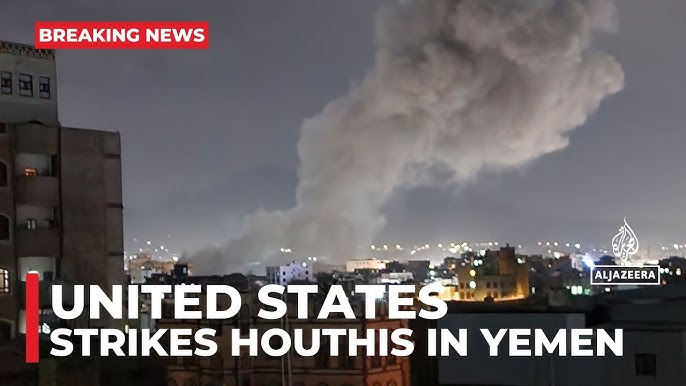
US Attack on Yemen May Spark War With Iran

In a dramatic escalation of Middle Eastern tensions, US President Donald Trump has ordered decisive military strikes against Houthi forces in Yemen. He declared that the United States would deploy overwhelming lethal force until its strategic objectives were achieved.

Trump justified the campaign by accusing the Houthis of engaging in piracy, violence, and terrorism against American and allied ships, aircraft, and drones in the region. He vowed that no terrorist group would be allowed to interfere with global shipping routes, asserting that American commercial and naval vessels must sail freely through international waterways without fear of attack.

Western media reports have extensively covered the Houthis’ ongoing attacks on shipping vessels in the Red Sea. It is alleged that the Houthis are backed by Iran. They claim their actions are a direct response to Israel’s military campaign in Gaza. They argue that their attacks are acts of solidarity with Palestinians suffering under Israeli bombardment. The group previously stated they would halt hostilities in the Red Sea if Israel agreed to a ceasefire with Hamas.

Trump’s rhetoric left no room for negotiation. "Support for the Houthi terrorists must end immediately," he declared. "Do not threaten the American people, their President, or worldwide shipping lanes. If you do, beware, because America will hold you fully accountable, and we won’t be nice about it."

His statements signaled a stark warning to regional powers, particularly Iran, which has long been accused of arming and financing the Houthis.

The strikes on Yemen are increasingly viewed not just as an attack on the Houthis, but as the opening of a larger, more dangerous proxy war between the United States and Iran.

While the Houthis themselves are a localized force, their ties to Tehran position them as a key player in the broader struggle for influence across the Middle East.

Iran insists its nuclear program remains peaceful, yet tensions with Washington and its regional ally, Israel, continue to escalate.

Iran’s support for groups like the Houthis, Hezbollah in Lebanon, and various militias in Iraq and Syria are seen by Western powers as efforts to project power and undermine US and Israeli interests.

International condemnation of Israel’s military actions in Gaza continues to grow, with many accusing the country of committing genocide against Palestinians.

The humanitarian crisis in Gaza has fueled anger across the Middle East, amplifying support for groups like the Houthis who present themselves as defenders of the Palestinian cause.

This complex web of conflicts — Israel’s actions in Gaza, Iran’s regional influence, and US intervention — is increasingly pulling global powers into a dangerous confrontation.

Trump’s military stance is not likely to secure shipping routes in the short term, but it risks inflaming an already volatile region.

With Iran’s deep-rooted influence in Yemen and beyond, the US may find itself drawn further into an extended, unpredictable conflict — one with consequences that could reverberate far beyond the Middle East.